



Anesthesia
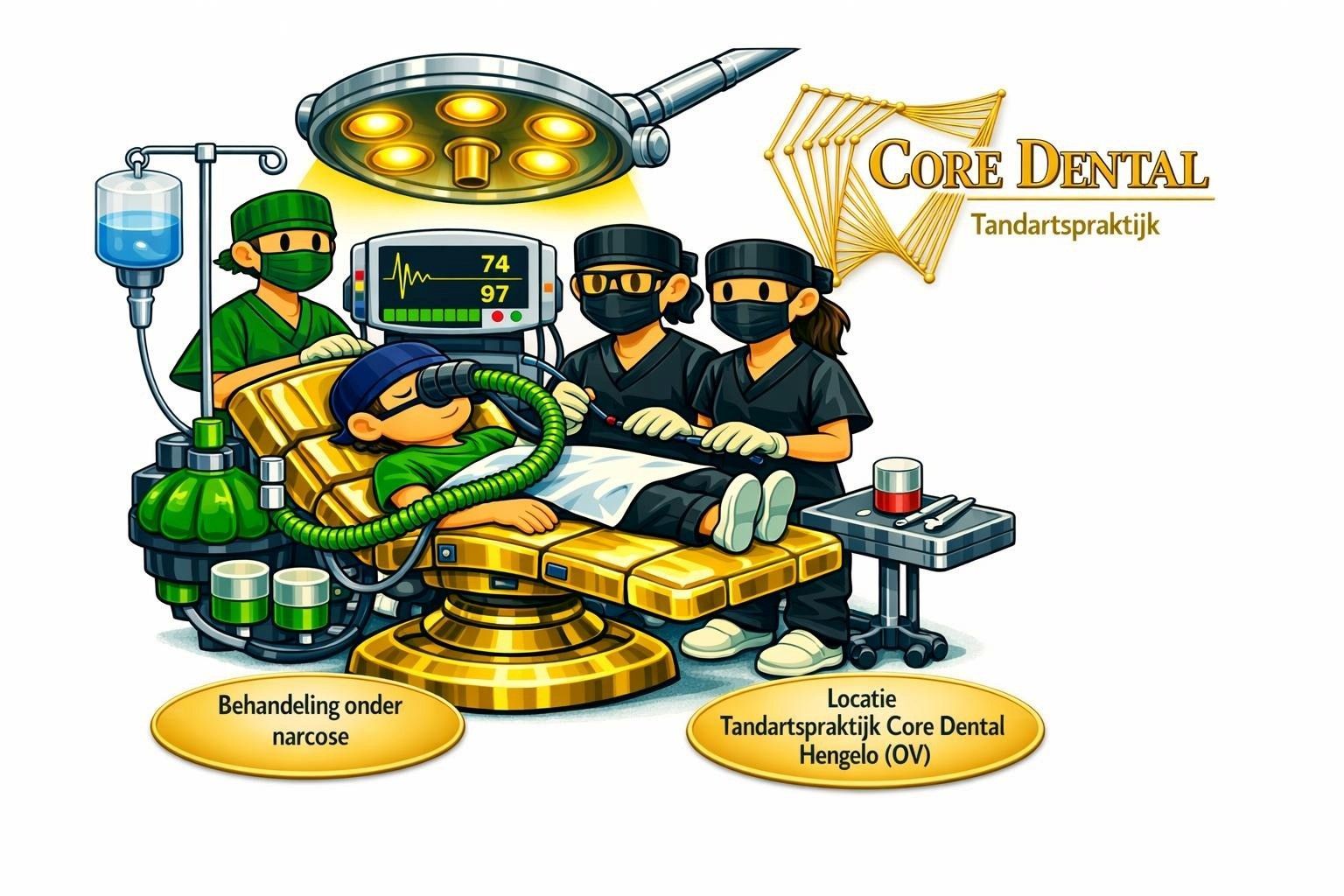
Treatment under general anesthesia
If you have dental anxiety or if treatment is impossible due to a gag reflex, treatment under general anesthesia can help. Treatment under general anesthesia can also be performed for a total extraction (a procedure in which all teeth must be extracted).
You may wish to undergo a treatment under general anesthesia soon. We would like to provide you with useful information regarding anesthesia, should you wish to proceed with the treatment. Ever wonder what anesthesia day looks like? Check out this quick video from our location:
Treatment planning:
You will receive the date of the treatment from the planning department. The exact time will be communicated to you by telephone 2-3 weeks in advance. You are requested to arrive at least 30 minutes beforehand.
Preparations at home for anesthesia:
On the day of the treatment, the following rules apply to anesthesia:
- If the treatment is before 12:00, you may not eat after midnight the evening before.
- If the treatment is after 12:00, you may eat one rusk at 6:00 in the morning.
- Up to 2 hours before the operation, you may only drink water or tea (without milk). Therefore, other drinks such as coffee, milk, or soft drinks must not be consumed.
- You must stop smoking at least 6 hours before the treatment.
- If you already have a partial denture, it must be removed before treatment under general anesthesia is started.
- Artificial or gel nails must be removed from at least one finger.
- Nail polish must be removed from at least one finger.
- Preferably remove all jewelry and piercings in the mouth at home before you come.
Failure to follow these recommendations can have far-reaching adverse consequences for your health during treatment under general anesthesia. It is therefore entirely in your best interest to strictly adhere to these instructions. To avoid putting you at unnecessary risk to your health, treatment under general anesthesia will not be performed if it becomes apparent that the instructions have not been followed.
The anesthesia:
Below is a brief explanation of the steps that will be followed for the treatment under general anesthesia:
De screening:
Before you can be treated under general anesthesia, you are required to complete an extensive medical questionnaire so that the anesthesiologist can properly assess your health condition and keep any potential risks to you as low as possible. If necessary, additional examinations may be requested (such as an electrocardiogram or blood tests), or additional information may be requested from your general practitioner or treating specialist.
Only after all necessary information has been received and assessed by the anesthesiologist can approval be given for treatment under general anesthesia. If the risks to your health prove to be too high, the anesthesiologist may reject the treatment under general anesthesia. You should be aware that this could also happen to you.
Monitoring:
Just before you go under anesthesia, you will be connected to the monitor. You will have stickers placed on your chest to monitor your heart rhythm, a blood pressure cuff that will measure your blood pressure every few minutes, and a sensor on your finger to measure the oxygen level in your blood.
Only after these things are connected can the anesthesia start.
Inserting IV:
Because we use total intravenous anesthesia (TIVA), an IV line must first be inserted. This means that you will receive an injection in your hand or forearm and that the anesthetic agents will be administered directly into your bloodstream. If you are very apprehensive about the injection or are anxious about it, you can receive a prescription—provided you indicate this in advance—to pick up a special patch at the pharmacy that can numb the skin before the injection is administered. If you pick up the special patch in advance and bring it to the clinic on the day of your treatment, the anesthesiologist will apply the patch to the correct spot on your skin upon arrival.
Anesthetics:
The agents we use for anesthesia are the ultra-modern, very short-acting agents propofol and remifentanil. These agents have such a short duration of action that after discontinuation, you will wake up very quickly and have very little chance of experiencing unpleasant side effects such as nausea and vomiting.
The anesthesia:
Once all monitoring equipment has been connected, the anesthetic will be slowly administered via the IV. This may cause a slightly stinging or burning sensation in your hand or arm. This is harmless and will disappear on its own. Just before you doze off, you will be given an oxygen mask. After that, you will go to sleep. We will wake you up as soon as the treatment is finished.
Since we do not use muscle relaxants at all, it is completely out of the question that you will wake up during the treatment but be unable to move (as in some movies). Therefore, you do not need to worry about this at all.
Recovering after anesthesia:
After the treatment is finished, you will wake up in the dentist's chair. Once you are awake, you will be transferred in a wheelchair to a room where you can rest quietly in a recliner. Your companion may stay with you until you have recovered sufficiently to go home. The anesthesiologist will check in regularly to determine if you are ready.
Possible risks of anesthesia:
Anesthesia is currently the safest specialty in medicine with the lowest risks. It is so safe, in fact, that driving to the clinic is more dangerous than receiving anesthesia at the clinic. Nevertheless, there are a number of risks that will be briefly listed below:
- During general anesthesia, a small tube is inserted into the trachea through the throat using instruments. Damage to one or more teeth could occur during insertion.
- When you are under general anesthesia, some protective reflexes disappear, which could cause acidic stomach contents to rise and enter the lungs. This can lead to severe pneumonia. That is why it is very important that you strictly adhere to the fasting times as described above. By doing so, you significantly reduce the risk of complications.
- Blood pressure fluctuations may occur due to the anesthetics. We can manage this very well with medication.
- An allergic reaction may occur after the injection of anesthetics. We can manage this very effectively with medication.
- Cardiac arrhythmias can occur due to the anesthetics. We can manage this very effectively with medication and equipment.
- If you are prone to it, an asthma attack may be triggered by the insertion of the tube into the trachea. We can manage this very effectively with medication. However, it is important that you always take any medication you use for your lungs (such as inhalers) properly in the days and morning before the treatment, and that you also always bring the medication with you on the day of the treatment.
- You may experience some nausea or even vomit after the anesthesia. We can generally manage this very well with medication.
After the treatment:
As soon as you have recovered sufficiently and the anesthesiologist has given their approval, you may go home. For your own safety, it is of great importance that you observe the following rules before you are allowed to go home:
- You are not allowed to drive.
- You are not allowed to go home alone
- You must not be alone for the first 24 hours after the treatment.